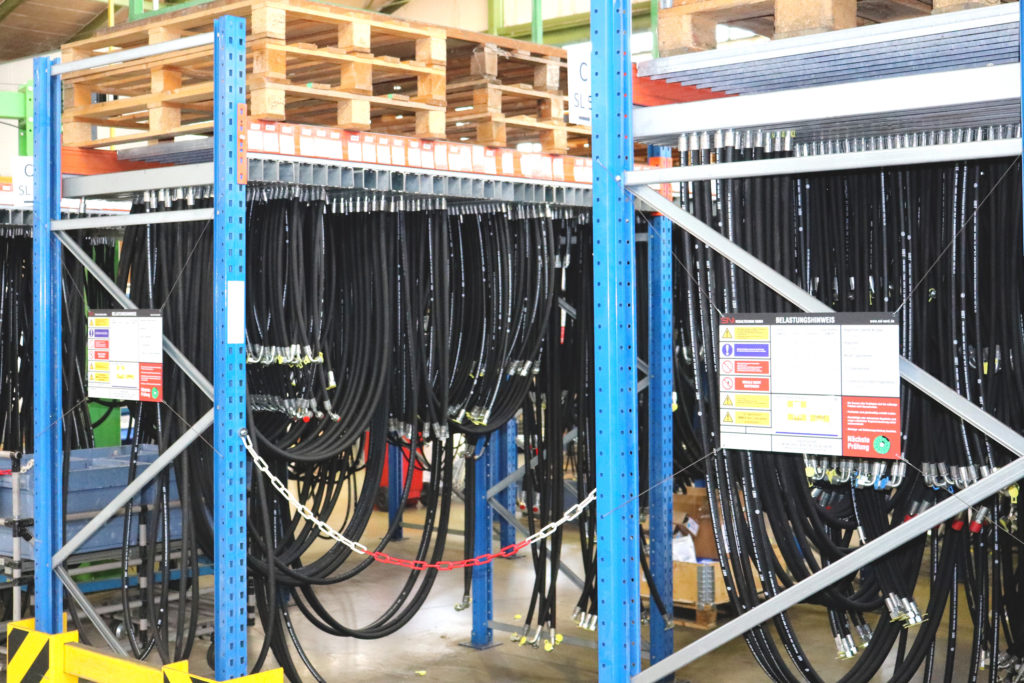
KANBAN hose rack from the HBT GROUP
In today's industrial production, the efficient management of supply chains is a key success factor. Especially in the pneumatics and hydraulics industry, which is characterized by complex systems and a wide variety of components, the KANBAN system is becoming increasingly important. It helps companies to optimize their material flows, reduce storage costs and increase the availability of important components and items. and articles availability of important components and items. In this article, we explain how KANBAN is used in hydraulics, what advantages it offers and how the "First In, First Out" (FIFO) principle ensures high quality and process reliability.
Basics of the KANBAN system
KANBAN originated in the automotive industry in Japan and was developed as part of the lean management concept. It is a pull system that aligns production and replenishment with actual consumption. Instead of large stockpiles and complex ordering processes, items are only reordered when the stock has reached a previously defined minimum value. This approach prevents overstocking, minimizes waste and ensures lean logistics.
In hydraulics, where components such as hydraulic hoses, valves, pumps or pipelines are required in a wide variety of designs, efficient material control is particularly important. This is where KANBAN comes in by ensuring a continuous supply without blocking storage space with unnecessary stocks.
The KANBAN system usually works with so-called Kanban containers. A container is only refilled or reordered when it is empty or the stock falls below a defined threshold. This visual signal triggers the reordering and thus ensures a needs-based material flow.
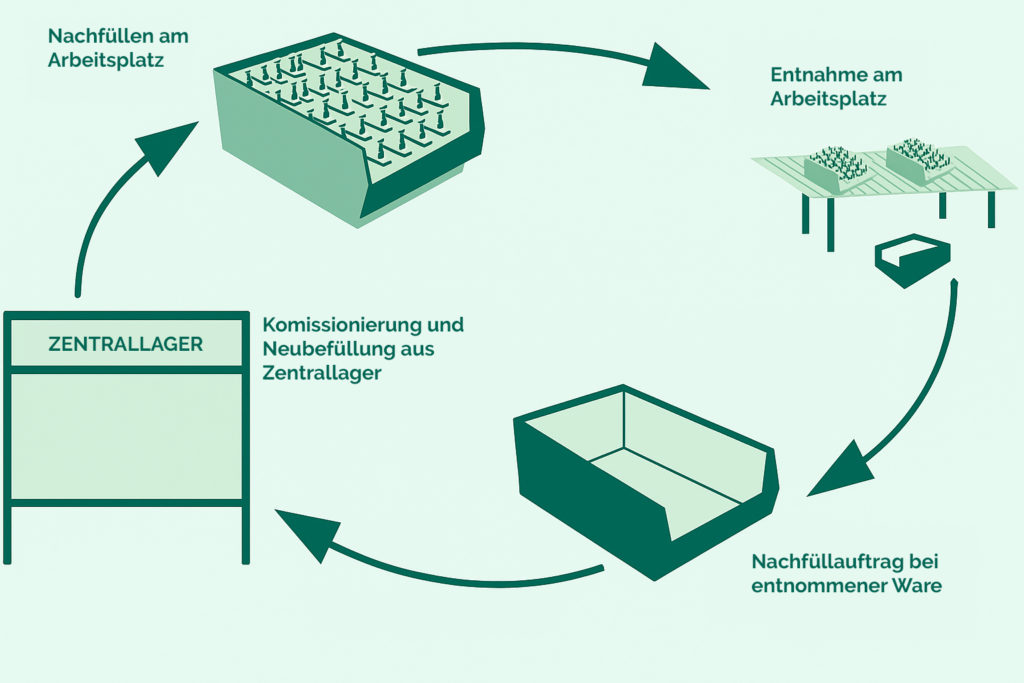
KANBAN control loop
Application of KANBAN in the hydraulics industry
The implementation of KANBAN in hydraulics poses particular challenges. Hydraulic components are often individually configured, vary greatly in size, material and function and sometimes have long delivery times. Too much stock ties up capital and storage space unnecessarily, while an undersupply can quickly lead to production downtimes and delays - an area of tension that needs to be mastered with well thought-out material management.
In the KANBAN system, precisely defined quantities of material are stored in standardized containers or storage areas. The size of the containers or storage areas is based on the average consumption within a defined period of time, so that a needs-based supply is guaranteed. Through regular refill cycles, the system adapts flexibly to fluctuations in consumption and enables continuous transparency regarding the material status, as each container serves as a visual control element.
The HBT GROUP offers a clear example of practical implementation with its hose racks (see cover picture). These racks are specially designed to store hydraulic hoses efficiently and in accordance with FIFO. The hoses are hooked into the racks from the rear and removed from the front so that the hoses stored first are always used first. This structure prevents material from becoming obsolete, ensures quality and supports compliance with the FIFO principle in a simple way.
In addition to internal organization, close cooperation with suppliers also plays an important role. suppliers also plays a decisive role. The replenishment processes can be precisely coordinated with the KANBAN rhythm so that deliveries are made on time. This reduces buffer stocks, minimizes capital commitment and makes the entire supply chain more efficient. A major advantage of the KANBAN system is its unlimited expandability. The HBT GROUP supports you with options ranging from rubber mats, sheet metal parts and screws to consumables.
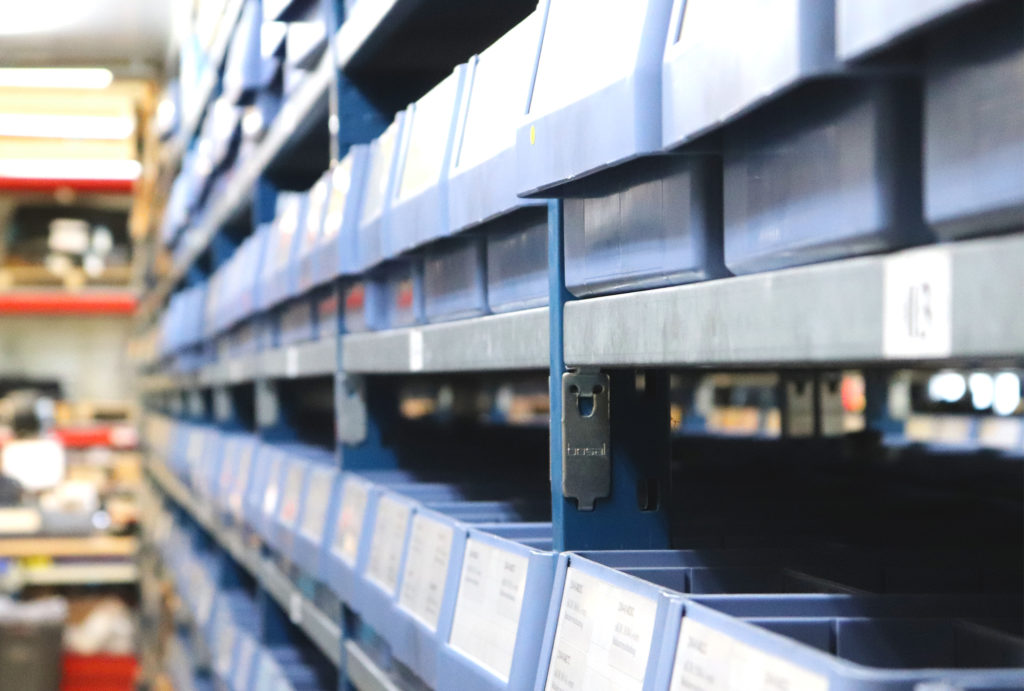
KANBAN shelf with containers
Optimization of the supply chain and process reliability with KANBAN
KANBAN not only creates transparency and efficiency, but also makes a significant contribution to process reliability. Reliable delivery times and high component quality are essential in hydraulics, as faulty or delayed parts can lead to failures or safety-critical situations.
KANBAN's demand-oriented reordering prevents material bottlenecks and ensures that production can run continuously. Bottlenecks or overstocks become visible and can be rectified at an early stage, containers remain continuously filled. In addition, production plans can be better coordinated with material availability, which reduces throughput times.
One of the key challenges is ensuring a smooth flow of materials while simultaneously maintaining quality assurance at the site. Compliance with the FIFO principle plays a decisive role here.
Ensuring FIFO in the KANBAN system
FIFO, "First In, First Out", means that the materials stored first are also used first. This procedure is particularly important in order to avoid material ageing, loss of quality or the risk of expiry. In hydraulics, this can include seals, hoses or special coatings whose properties change over the storage period.
To ensure FIFO in the KANBAN system, storage and replenishment processes must be clearly organized. The storage locations should be designed in such a way that older stock is always accessed first. This can be achieved using physical storage shelves with clear labeling or special shelving systems that ensure clear separation and sequencing.
In addition, visual aids such as color codes or date stickers are used to make the FIFO principle visible. Today, digital systems also support the tracking of material movements, batches and storage data on site. This allows employees to monitor stock levels at all times and ensure that older stock is used up first.
The combination of KANBAN and FIFO significantly increases transparency and process reliability in the supply chain. It prevents old or overstocked materials from entering the production process and thus ensures product quality.
Challenges and success factors during implementation
The introduction of a KANBAN system in hydraulics requires careful planning and adaptation to the individual company processes. The correct determination of Kanban container sizes, the definition of replenishment quantities and intervals as well as the training of employees are decisive factors for success.
Integration with existing ERP and warehouse management systems is also important in order to ensure a continuous flow of information. Close cooperation with suppliers also plays a central role, as their response times and delivery reliability have a significant influence on the function of the KANBAN system.
Another point is constant monitoring and adaptation. Consumption quantities can change, production processes evolve and the product range can also vary. It is therefore important to check the KANBAN parameters regularly and adjust them if necessary in order to continue to achieve optimum results.
Conclusion: Efficient supply chain thanks to KANBAN and FIFO - with the support of the HBT GROUP
The KANBAN system offers the hydraulics industry an effective method of making material supply lean, flexible and transparent. It reduces storage costs, avoids bottlenecks and helps to stabilize production. By consistently ensuring the FIFO principle, the quality of the components used is also guaranteed and process reliability is increased.
The HBT GROUP supports companies with many years of pneumatics and hydraulics expertise in the planning and implementation of a KANBAN solution tailored to your needs. From the analysis of your supply chains to the selection of suitable storage and control processes and the integration of modern IT systems, we work in partnership with you. In this way, we ensure that your company benefits from the advantages of an optimized material flow and that your hydraulic supply functions reliably at all times.
Are you looking for a competent partner for your hydraulic solutions? Feel free to contact us and benefit from our many years of experience.