
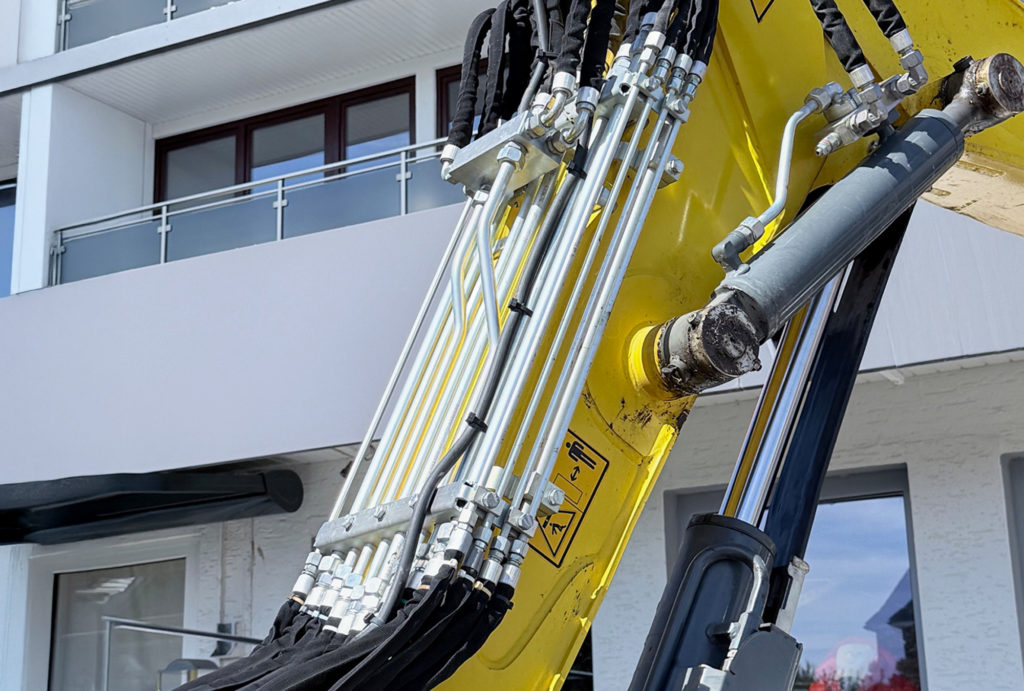
Hydraulic lines on an excavator
Hydraulic systems are the driving force in many industrial sectors, from mechanical engineering to agricultural and marine technology to construction. They move loads weighing tons, work under extreme pressure and are often used in harsh environments. At the same time, this performance also entails risks. Anyone working with hydraulic systems must be aware of the dangers and pay consistent attention to safety. Accidents involving hydraulic components can have serious consequences: from serious injuries to high material and downtime costs.
In this article, you will find out which sources of danger are particularly common, which regulations apply and how you can ensure greater safety with practical measures.
Pressure and energy
Hydraulics workt with extremely high pressuresüpressures. Pipespipes, hoses, valves and storage vessels are often subjected to loads of several hbar. An accidentally loosened hose or an uncontrolled leakage ofthe oil jet can act like a projectile and cause injuries within fractions of a second. The following therefore applies on a system must thisdepressurized depressurized. Hydraulic motors must be stopped and, if necessary, lever systems must be mechanically blocked to prevent movement. Lines must never be opened as long as there is residual pressure.
Leaks and injection injuries
Leaks are one of the biggest sources of danger. Even the smallest cracks or defective seals can cause oil to escape under high pressure. Injection injuries are particularly treacherous: Hydraulic oil can penetrate the skin under high pressure. What initially only looks like a small puncture wound can lead to severe tissue and nerve damage within a few hours, which in extreme cases may require amputations.
Leaks should therefore never be searched for by hand. Instead, tools such as cardboard, pieces of wood or special leakage sprays should be used. If hydraulic oil penetrates the skin, medical assistance is required immediately; any delay increases the risk of serious consequences.

Injection injury to the hand
Check hoses, lines and couplings regularly
Hoses and pipes are the arteries of the hydraulic system. They are exposed to high pressures, changing temperatures and often mechanical loads. Cracks, abrasion points and porous surfaces develop gradually, but can lead to sudden bursting in an emergency. Regular visual inspections are therefore essential.
Only approved hoses and fittings that are approved for the respective pressure range may be used. Hoses must be laid correctly - without kinks, twists or contact with sharp edges. Abrasion protection must be used where there is a risk of abrasion. Defective components must not be repaired but must be replaced immediately.
Personal protective equipment (PPE)
Even the best technology does not protect against all hazards. This is why personal protective equipment is mandatory when working on hydraulic systems. Safety goggles protect the eyes from splashes, gloves reduce the risk of injury to the hands and safety shoes prevent injuries from falling parts. Hearing protection is also required for particularly loud systems or test benches.
Cleanliness protects people and machines
Hydraulic systems are sensitive to contamination. Dirt particles can not only damage components, but can also lead to dangerous situations if valves block or pressure conditions fluctuate uncontrollably. Cleanliness is therefore the top priority when working. Oil may only be poured into clean, closed containers. Spilled oil must be cleaned up immediately, as it is not only a fire hazard but also a slip hazard. A clean working environment when handling hydraulics protects both the technology and the people who work with it. You can find out more about oil cleanliness in the corresponding technical article.

Clean vs. contaminated hydraulic oil
Commissioning and maintenance
Work on hydraulic systems may only be carried out by trained specialist personnel. Before any maintenance or repair work, the machines must be shut down, secured against restarting and the pressure completely released. The lockout-tagout procedure (LoTo) is used here, in which machines are locked in such a way that no unintentional restart is possible.
Safety devices such as pressure relief valves or emergency stop switches must never be bypassed or put out of operation. They are crucial for protecting people and systems in the event of an emergency.
Do not neglect fire protection
Many hydraulic oils are flammable. Open flames, sparks or other sources of ignition must therefore never be in the vicinity of hydraulic machinesmachines. Suitable fire extinguishers, usually foam or powder extinguishers, must be readily available at all times. Companies are obliged to regularly train employees in the use of these devices.
Standards and regulations
Safety when working with hydraulic systems is not just a matter of common sense, it is also regulated by law. In Germany, the Occupational Health and Safety Act obliges companies to take measures to protect their employees. The Industrial Safety Ordinance stipulates that work equipment must be used safely and that regular inspections must be carried out. In addition, there are special regulations such as DGUV Rule 113-020 for hydraulic hose lines and fluids, the Machinery Directive and the Pressure Equipment Directive.
These standards and laws form the legal framework, but are also an expression of our ethical responsibility: the health and lives of our employees must have top priority at all times.
Typical injuries and why prevention is so important
Accidents involving hydraulic systems are often more dramatic than one might initially expect. High-pressure injection injuries, which appear harmless on the outside but can actually cause extremely serious tissue damage, are particularly dangerous.
Burns or scalds caused by hot liquids or surfaces are also not uncommon. There are also crushing injuries, bruises or cuts caused by damaged cables or bursting parts.
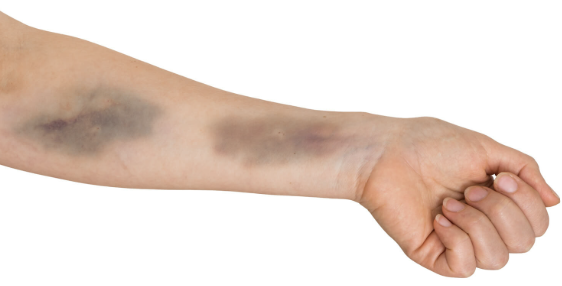
Bruises on the arm
Hands and eyes are particularly at risk. Hand injuries are among the most common workplace accidents in the industrial sector, while eyes are at risk from splashes and flying parts. The consistent use of protective equipment and compliance with safety regulations are therefore essential.
Conclusion: Safety has top priority
Hydraulic systems are powerful and reliable, but only if they are operated safely. High pressure, potential leaks, fire risks and mechanical loads make hydraulics a field of work where care is vital. Regular inspections, consistent maintenance, the right protective equipment and compliance with all regulations are not optional, but mandatory.
The HBT GROUP supports you with expertise, experience and a clear focus on safety. We ensure that your hydraulic systems are not only reliable, but also safe to operate. After all, protecting people and machines is the basis for long-term success.
Are you looking for a competent partner for your hydraulic solutions? Feel free to contact us and benefit from our many years of experience.
Specialist article by:

Hans-Peter Löw
Managing Director HBT GROUP
Over three decades of management experience in manufacturing companies in various industries